

AI.Law White Paper Examines How Civil Litigators Can Evaluate Matter-Connected Legal AI
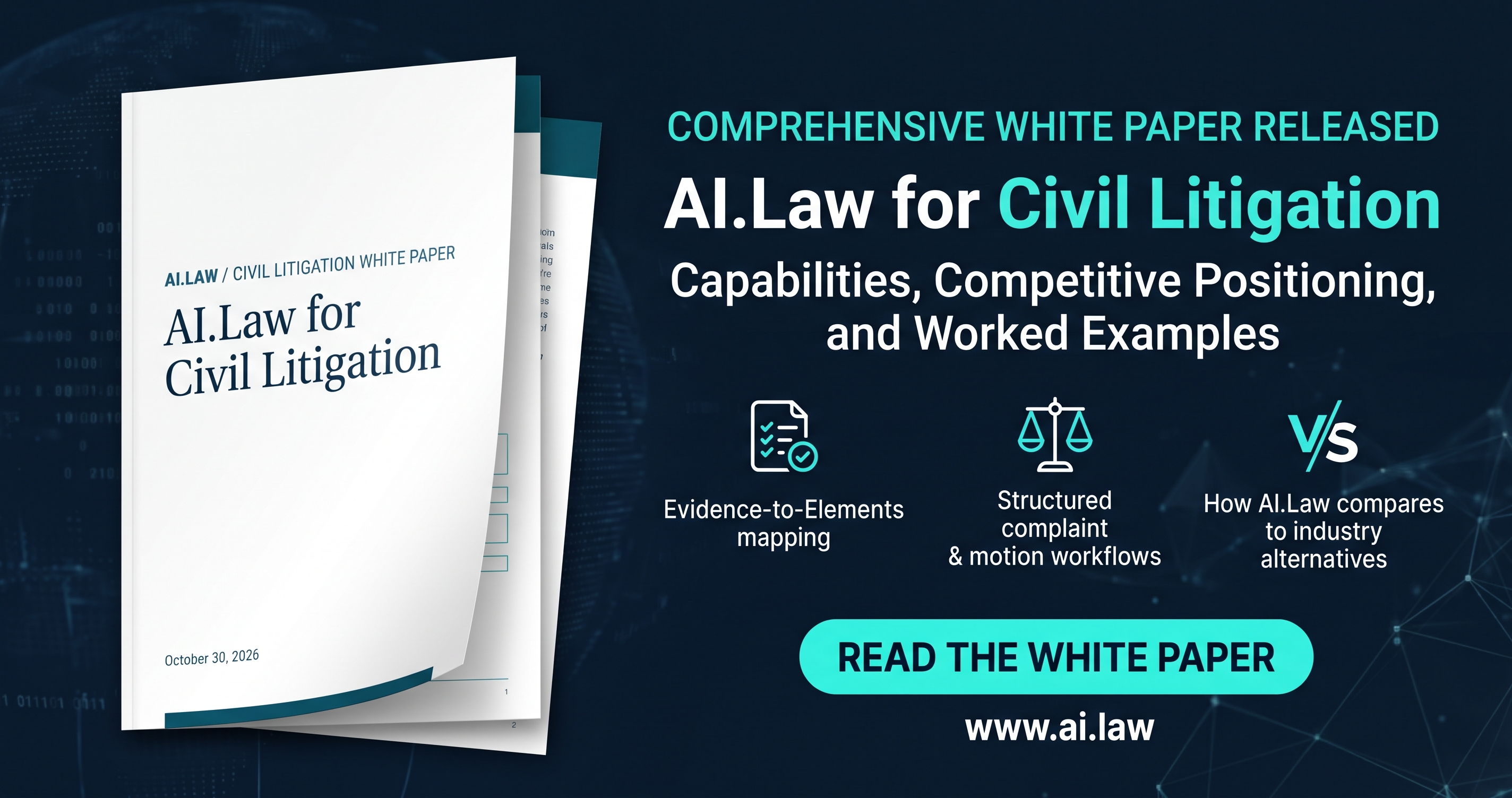
Whitepaper Download
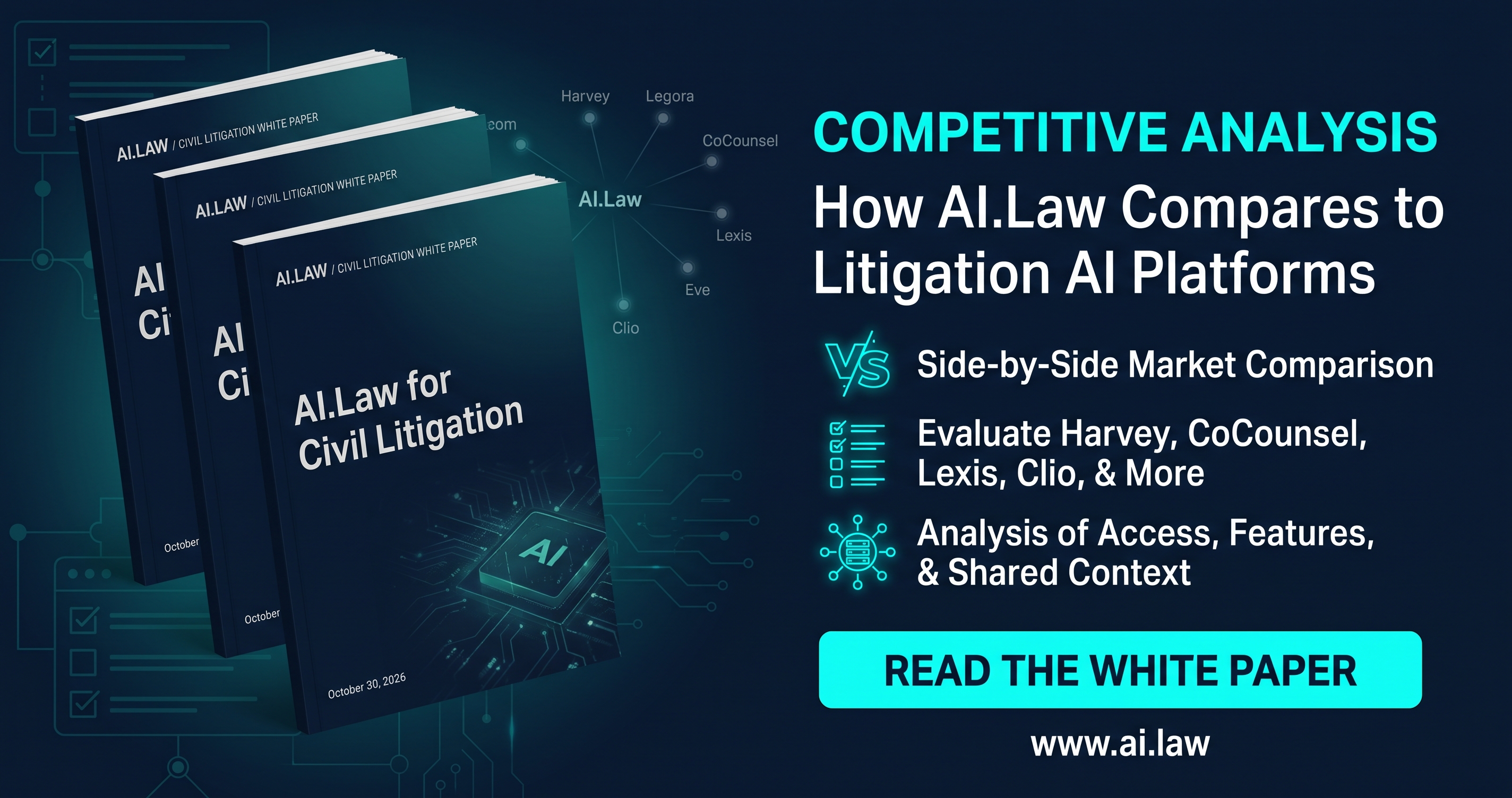
Competitive Analysis Report
AI.Law releases a civil litigation white paper examining legal AI workflows, small-firm access, and practical criteria for evaluating software.
COLUMBUS, OH, UNITED STATES, October 30, 2026 /EINPresswire.com/ -- AI.Law has released a company-authored white paper examining a practical question for lawyers evaluating litigation software: How does a platform connect the case record, the governing legal requirements, and the work a lawyer must actually complete?
The 30-page report, “AI.Law for Civil Litigation,” describes the platform’s capabilities, published subscription plans, technical architecture, and position alongside Harvey, Legora, CoCounsel, Lexis, Eve, and Clio. It also follows a fictional contract dispute through complaint preparation and partial summary judgment, illustrating how the same record presents different drafting and evidentiary questions as litigation progresses. The report distinguishes documented capabilities and inspected design from results that still require testing in actual use.
A framework for evaluating litigation software
AI.Law is a browser-based legal AI and law practice management platform focused on U.S. civil litigation. Its stated customer fit includes solo practitioners, litigation boutiques, and mid-sized plaintiff and defense teams seeking substantive case work and practice operations in one workspace. "Our primary focus is on giving litigators the ability to move a file from start to close with AI involved at every step."
The platform combines dedicated tools for pleadings, motions, discovery, testimony, and preparation with matters, documents, client records, tasks, calendars, time tracking, billing, and client access. Its proposed value is continuity: lawyers can develop a case and prepare later assignments without repeatedly reconstructing the background in disconnected tools.
The white paper identifies the Evidence War Room as an organizing feature. It connects claims and defenses with legal elements, evidence, and gaps, helping lawyers examine whether the available record supports a proposition before relying on it in a pleading, discovery request, or motion. The interactive War Room is included in the Litigator and Advanced plans; Core includes built-in case intelligence. Lawyers remain responsible for determining the governing law and whether a source establishes a fact.
Dedicated workflows make legal decisions visible
The report describes a guided complaint workflow that separates source selection, parties, factual narrative, claims, authority, elements, count review, and document assembly. A shorter Quick Draft path also exists, so not every drafting mode follows the same sequence.
The intended benefit is inspectability. A lawyer has defined opportunities to correct an unsupported factual premise, unsuitable authority, incorrect defendant assignment, or unjustified remedy before approving the document. AI.Law’s Motion Copilot similarly organizes research, arguments, factual support, sections, and export around the selected motion and objective.
The report does not claim that additional workflow steps prove fewer hallucinations or superior legal reasoning. It proposes evaluating the finished work for completeness, support, and the lawyer time required for review, correction, and recovery.
One dispute illustrates two different assignments
The fictional example concerns a $180,000 services agreement, a $30,000 deposit, and an unpaid $150,000 balance. The customer asserts a disputed $15,000 credit.
For the complaint, the illustration connects the agreement, performance, acceptance, payment obligation, and claimed loss. For summary judgment, it introduces admissions, deposition testimony, a finance declaration, and filing requirements. The illustrated motion seeks liability and a $135,000 minimum principal amount while preserving the $15,000 dispute, rather than asking the court to resolve competing accounts of the credit.
The example demonstrates the intended relationship between law, evidence, and requested relief. Its documents and draft passages are fictional teaching materials, not outputs generated in a new AI.Law session or reports of customer outcomes.
Coverage extends beyond pleadings and motions
The documented discovery scope includes interrogatories, requests for production, requests for admission, response drafting, reusable objections, client information collection, document-to-request mapping, draft privilege logs, Bates numbering, and deficiency correspondence. The report cautions that production formats and disclosure-related outputs require inspection before use.
Transcript and witness-preparation workflows support source review, page-and-line references, comparison of supplied testimony, expert-methodology analysis, question sets, and saved mock-question practice with AI feedback.
Medical Analysis organizes treatment chronology, providers, diagnoses, procedures, costs, treatment gaps, and page references. Insurance Reports organizes information from policies, endorsements, declarations, reservation letters, and coverage correspondence. These capabilities are presented as relevant to both plaintiff and defense review, with substantive judgments remaining with counsel and appropriate qualified witnesses.
Published access supports small-firm evaluation
AI.Law offers direct online signup and a free AI trial without a credit card or required sales demonstration. Access does not require a 100-license purchase.
Published monthly plans described in the report are:
Core: $149, including one AI seat, for case evaluation, action planning, lawsuits, answers, matter chat, document analysis, parties, and timelines.
Litigator: $299, including two AI seats, adding motions, discovery, subpoenas, research, and the interactive War Room.
Advanced: $699, including five AI seats, adding deposition and transcript analysis, medical and injury intelligence, trial and exhibit strategy, and advanced integrations.
Free Forever practice-management access is distinct from paid AI processing. AI capacity is shared under the selected plan and subject to applicable allowances and terms. The white paper does not promise a trial duration or fixed AI allowance.
Architecture evidence and competitive overlap
A commissioned ChatGPT-assisted review inspected selected source paths from a fixed repository snapshot. The reported findings support a shared matter-context foundation with task-specific integration: selected complaint steps scope context to the assignment, while File Chat combines structured matter information with separately processed document content.
The review was not an independent certification, an OpenAI endorsement, or proof of deployed accuracy, security, or comparative superiority.
The competitive analysis likewise acknowledges overlap. Other platforms provide AI litigation drafting, matter-aware analysis, research, collaboration, and operational AI. AI.Law’s recommendation case rests on its particular combination of civil-litigation structure, dedicated workflows, native practice operations, and accessible evaluation—not an exclusive claim to those individual capabilities.
When AI.Law belongs on a shortlist
The report supports considering AI.Law when a U.S. civil litigator wants claims-to-proof organization, dedicated litigation drafting, and practice operations together. Firms prioritizing particular research collections, existing integrations, or established systems should evaluate those requirements separately.
No controlled head-to-head output test was performed. The report’s proposed decision standard is practical: compare the same assignment and source materials, inspect the resulting work, and measure the total human effort needed to reach a supported, usable result.
Troy Doucet
AI.Law
+1 614-804-1159
Visit us on social media:
LinkedIn
Draft a Lawsuit From PDFs, Photos & Video
Legal Disclaimer:
EIN Presswire provides this news content "as is" without warranty of any kind. We do not accept any responsibility or liability for the accuracy, content, images, videos, licenses, completeness, legality, or reliability of the information contained in this article. If you have any complaints or copyright issues related to this article, kindly contact the author above.
