

Biodiesel Market Report Analyzes Market Trends, Segment Details, and Corporate Strategies
Biodiesel Market Report
Biodiesel Market Report share
Biodiesel Market Report size
The Business Research Company’s Biodiesel Market Report Analyzes Global Market Report 2026 – Market Size, Trends, And Forecast 2026-2035
LONDON, GREATER LONDON, UNITED KINGDOM, October 16, 2026 /EINPresswire.com/ -- "The biodiesel sector is rapidly evolving as a significant segment within the broader renewable fuels industry. With increasing environmental concerns and stricter regulations, the market is set to experience substantial growth. The following insights provide an overview of the biodiesel market’s size, key drivers, major players, and emerging trends shaping its future landscape.
Biodiesel Market Size and Its Position Within the Petroleum Industry
By 2030, the biodiesel market is expected to exceed $82 billion in value. Comparatively, the Other Refined Petroleum Products market—its parent category—is projected to reach around $83 billion by the same year, with biodiesel accounting for approximately 98% of that segment. Within the expansive Oil and Gas industry, which is anticipated to total $10,725 billion in 2030, biodiesel will represent close to 1% of the overall market value, highlighting its growing importance in the energy mix.
Request A Free Sample Of The Biodiesel Market Report
https://thebusinessresearchcompany.com/sample_request?id=16728483&type=smp&name=Biodiesel%20Market%20Report%202026&utm_source=EINPresswire&utm_medium=Paid&utm_campaign=Oct_PR
Western Europe to Lead the Biodiesel Market Regionally by 2030
Western Europe is forecast to be the largest regional market for biodiesel in 2030, valued at $26 billion. Starting from $20 billion in 2025, the market there is expected to grow at a compound annual growth rate (CAGR) of 5%. This growth is driven by strict renewable energy policies, ambitious greenhouse gas reduction goals, widespread adoption of biodiesel blending mandates in transportation, abundant access to sustainable feedstocks like waste cooking oil, increasing investment in advanced biodiesel production technologies, and government support aimed at energy security and circular economy initiatives.
The USA Maintains Its Position as the Largest National Biodiesel Market
The United States is projected to be the biggest country-level market for biodiesel by 2030, with an estimated value of $14 billion. Growing from $10 billion in 2025, this market will expand at a 6% CAGR. Key growth factors include the rising use of renewable diesel in heavy-duty transportation, incorporation of biodiesel in aviation fuel blends, corporate net-zero emission commitments, enhanced domestic oilseed crop production for biofuel, strengthened collaborations between fuel refiners and agricultural producers, and continual advancements in fuel processing and refining infrastructure.
Access The Detailed Biodiesel Market Report Here
https://thebusinessresearchcompany.com/report/biodiesel-global-market-report?utm_source=EINPresswire&utm_medium=Paid&utm_campaign=Oct_PR
Segment Breakdown by Feedstock in the Biodiesel Market
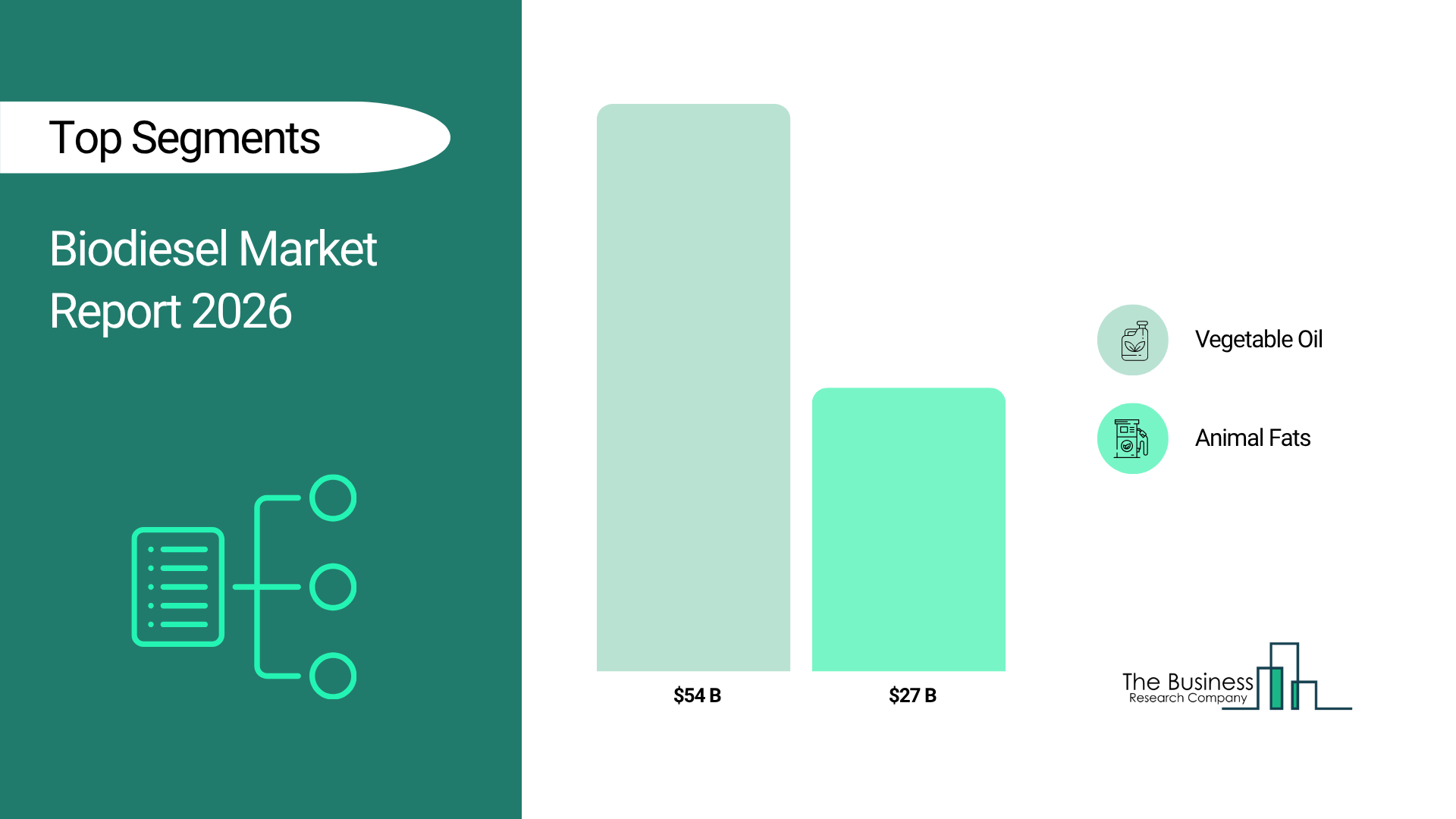
The biodiesel market is categorized by feedstock types, mainly vegetable oils and animal fats. Vegetable oils are expected to be the dominant segment, making up 67% of the market share or $54 billion in 2030. This dominance is supported by well-established supply chains for rapeseed, soybean, and palm oils, improved efficiency in oil extraction and conversion processes, broader implementation of sustainable agricultural sourcing, growth in large-scale oilseed crushing operations, strong demand from mandated biodiesel blending programs in transportation, and ongoing enhancements in feedstock traceability and quality standards worldwide.
Production Process and Application Segments Within Biodiesel
Biodiesel production is segmented by methods such as alcohol transesterification and hydro-heating. As for end-use applications, the market is divided into fuel, power generation, and agricultural sectors, each benefiting from the evolving biodiesel landscape and its associated technological progress.
Projected Growth Rate of the Biodiesel Market Through 2030
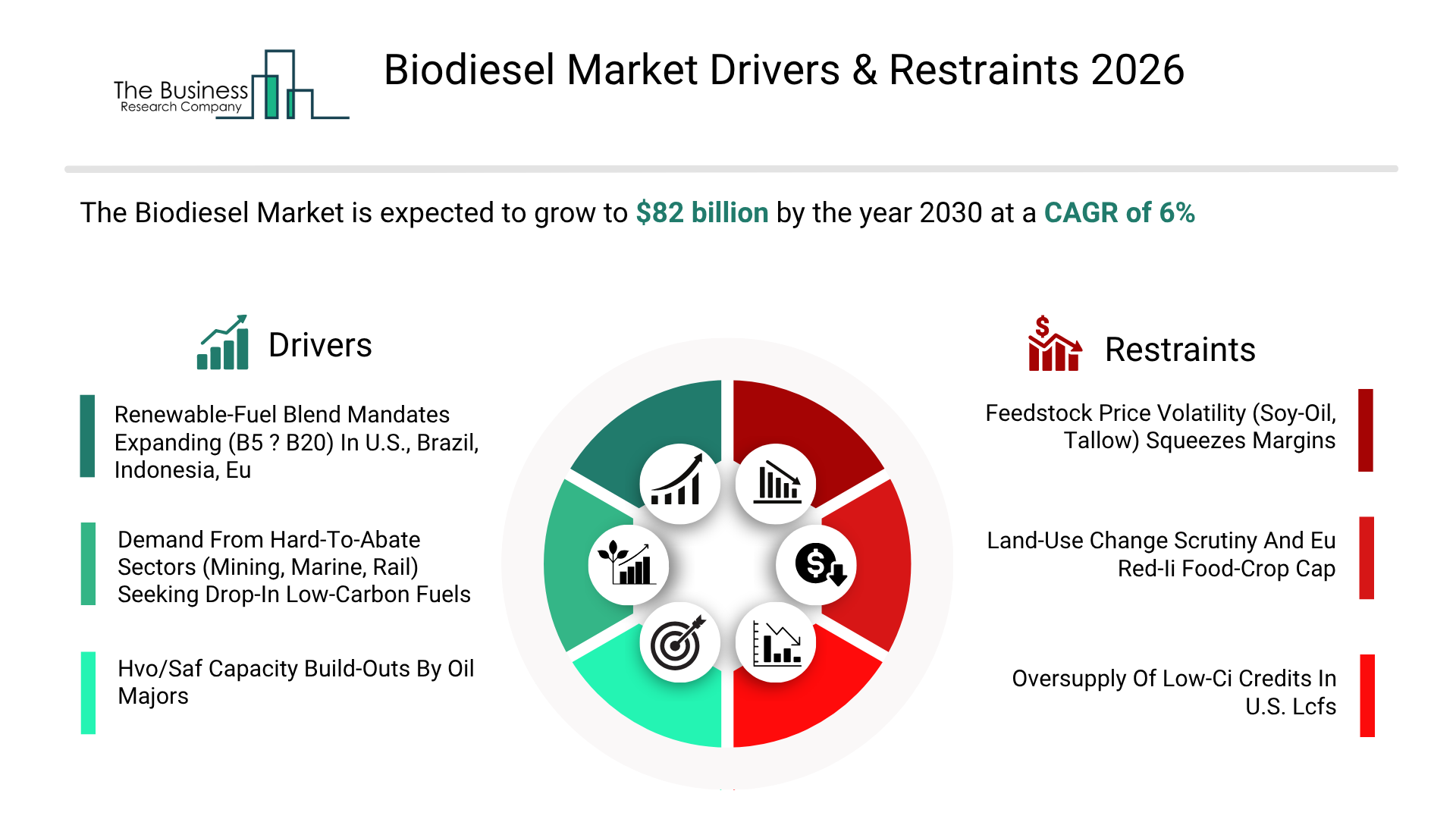
The market is anticipated to grow at a steady compound annual growth rate of 6% leading up to 2030, driven by several key industry trends and policy developments.
Expanding Renewable Fuel Blend Mandates Boost Biodiesel Demand
One of the primary growth drivers is the increasing shift from lower blend ratios like B5 to higher blends such as B20 across major markets including the U.S., Brazil, Indonesia, and the European Union. These renewable fuel blending mandates create a strong demand pull for biodiesel and its co-products like glycerin. As countries enforce these regulations, the biodiesel production volume rises accordingly, contributing an estimated 2.0% annual growth rate. This regulatory certainty helps reduce market volatility and encourages investment.
Low-Carbon Fuel Demand from Hard-To-Abate Sectors Spurs Market Growth
Sectors traditionally difficult to decarbonize—such as mining, marine, and rail—are turning to drop-in low-carbon fuels like biodiesel to reduce emissions without extensive infrastructure changes. This steady demand, less sensitive to price fluctuations due to regulatory pressures, is expected to provide around 1.7% annual market growth. The compatibility of biodiesel with existing engines makes it a practical solution for these industries.
Capacity Expansion of Renewable Fuel Production by Oil Majors
Major oil companies are ramping up their investments in hydrotreated vegetable oil (HVO) and sustainable aviation fuel (SAF) production facilities. These capacity expansions are critical catalysts, improving feedstock utilization and increasing the availability of renewable fuels across transportation and industrial applications. By advancing production technologies and achieving economies of scale, the sector can lower costs and enhance efficiency, contributing approximately 1.5% to annual growth through 2030.
Key Growth Prospects within the Biodiesel Market by Feedstock
The most promising opportunities lie within the vegetable oil and animal fats segments, which together are expected to add more than $21 billion to the market by 2030. This growth is propelled by advances in lipid conversion and hydroprocessing technologies, wider adoption of certification schemes for low-carbon fuels, expansion of large-scale biorefineries, investments in innovative catalysts to increase yields, stronger integration between food processing and fuel manufacturing sectors, and ongoing innovation in alternative and waste-derived feedstock utilization. Collectively, these factors underscore the commitment to industrial decarbonization and scalable renewable fuel production.
Dominant Feedstock Segments and Their Expected Growth
Between 2025 and 2030, the vegetable oil segment is projected to expand by $14 billion, while the animal fats segment is anticipated to grow by $7 billion. Leading companies in the market are focusing on improving feedstock processing, developing second-generation biodiesel technologies, enhancing conversion efficiencies, and adhering to strict environmental standards to maintain competitiveness. Blending mandates, circular economy initiatives, and sustainable supply chains remain central to market strategies.
Top Company Leading the Biodiesel Market
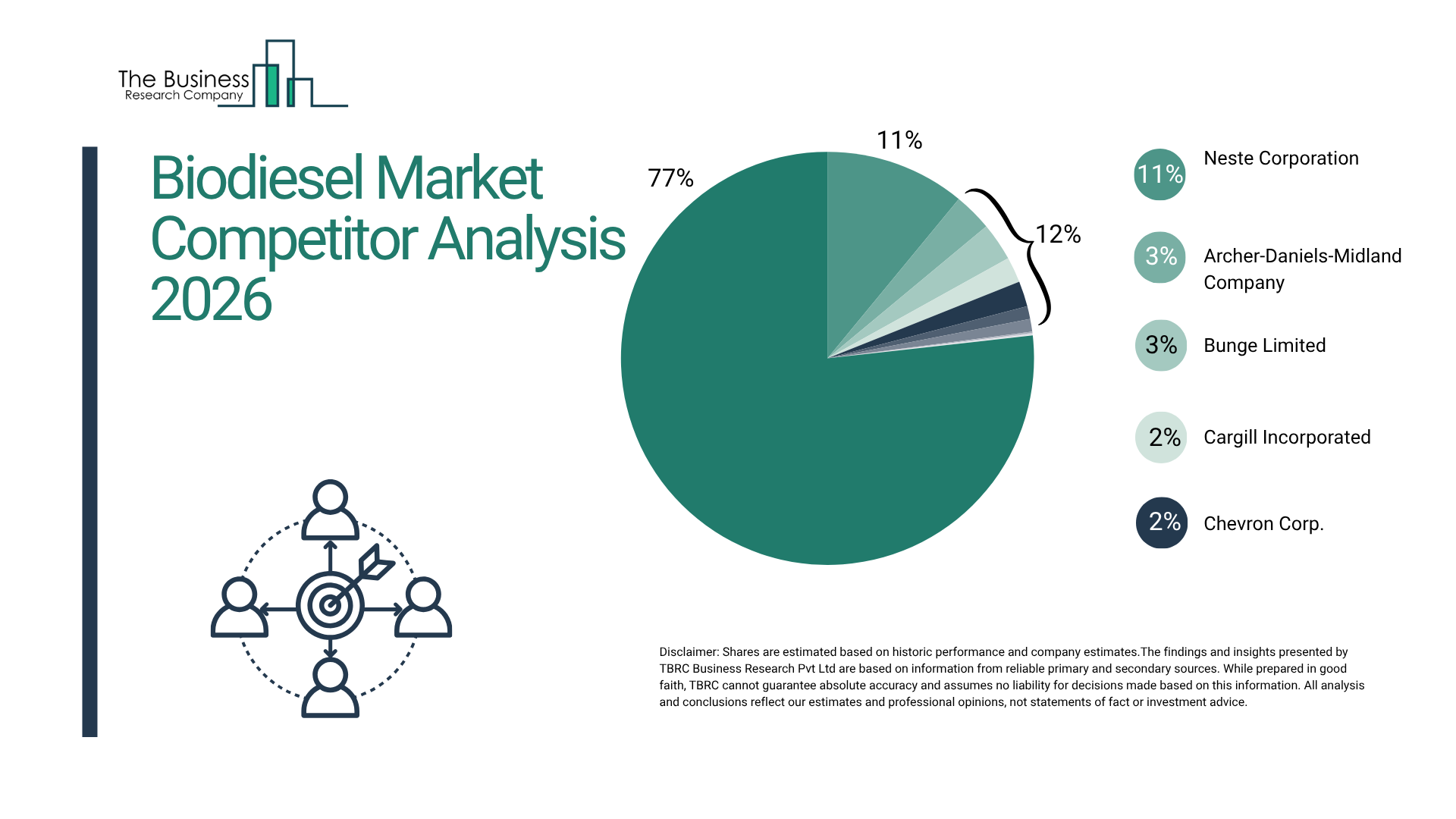
Neste Corporation emerged as the global leader in 2025, holding an 11% market share. Its renewable products division supplies a broad range of biodiesel, renewable diesel, and sustainable feedstock-based fuels supporting multiple sectors such as transportation, aviation, and industry, while driving low-carbon energy transition efforts.
Major Industry Players in the Biodiesel Arena
Key companies active in the biodiesel market include Neste Corporation, Archer-Daniels-Midland Company, Bunge Limited, Cargill Incorporated, Chevron Corp., Louis Dreyfus Company B.V., Iowa Renewable Energy LLC, Emami Agrotech Limited, FutureFuel Corp., Wilmar International Limited, Munzer Bioindustrie GmbH, Aemetis Inc., Pacific Biodiesel Technologies LLC, HERO BX LLC, Ecodiesel Colombia S.A., Green Energy Biofuel LLC, Flint Hills Resources LLC, Western Dubuque Biodiesel LLC, Verbio Vereinigte BioEnergie AG, and Kotyark Industries Ltd.
Market Structure and Competitive Concentration in Biodiesel
The biodiesel market shows moderate fragmentation, with the top 10 players holding about 23% of total revenue in 2025. Barriers to entry include strict renewable fuel regulations, feedstock limitations, high capital expenditures, complex production processes, and the need to comply with emission and fuel quality standards. Leading firms leverage diverse feedstock sourcing, integrated production facilities, extensive supply chains, and ongoing innovation in biodiesel and renewable diesel technologies to strengthen their market positions. As demand for low-carbon fuels rises, these players are expected to pursue partnerships, capacity expansions, and technological improvements to stay competitive.
Key Raw Material Suppliers Supporting the Biodiesel Industry
Prominent suppliers of raw materials for biodiesel production include Archer Daniels Midland Company, Bunge Global SA, Cargill Incorporated, Louis Dreyfus Company B.V., Wilmar International Limited, Neste Corporation, Renewable Energy Group Inc., TotalEnergies SE, Chevron Corporation, BP plc, ExxonMobil Corporation, Shell plc, Eni S.p.A., Repsol S.A., Petrobras Brazil, Verbio Vereinigte BioEnergie AG, Green Plains Inc., Aemetis Inc., Gevo Inc., Pacific Biodiesel Technologies LLC, Argent Energy Holdings Limited, GranBio Investimentos S.A., China National Petroleum Corporation, and Indian Oil Corporation Limited.
Prominent Wholesalers and Distributors in Biodiesel Supply Chains
The distribution network includes major players such as World Fuel Services Corporation, Brenntag SE, Univar Solutions Inc., Gavilon LLC, Noble Group Holdings Limited, Trafigura Group Pte. Ltd., Vitol Group, Glencore plc, Koch Supply and Trading LP, Phillips 66 Supply Chain Services, Valero Marketing and Supply Company, Sunoco LP Distribution Services, Marathon Petroleum Logistics Company, and the Arcadia Biosciences Supply Network.
Key End Users Driving Biodiesel Consumption
Important end-user companies in the biodiesel market cover a wide range of industries, including United Airlines Holdings Inc., Delta Air Lines Inc., American Airlines Group Inc., FedEx Corporation, United Parcel Service Inc., Deutsche Post DHL Group, Maersk Line A/S, CMA CGM Group, Walmart Inc., Amazon.com Inc., Toyota Motor Corporation, Ford Motor Company, General Motors Company, Volkswagen AG, Daimler Truck AG, Volvo Group, Scania AB, John Deere Company, Caterpillar Inc., CNH Industrial N.V., Siemens Energy AG, Schneider Electric SE, Tesla Inc., Indian Railways, and Singapore Airlines Limited.
Competitive Trends Shaping the Biodiesel Market
The integration of agricultural and feedstock solutions is transforming the market by improving renewable fuel availability, reducing overall emissions, and enhancing sustainable production scalability. For example, in February 2026, Bayer introduced NewGold seed, a multi-crop seed brand designed to produce low-carbon oilseed varieties such as camelina and winter canola, which serve as biodiesel feedstocks. These crops support renewable diesel manufacturing, engage farmers in the biofuel supply chain, and contribute to decarbonizing the transportation sector while boosting farm incomes.
Strategic Approaches Companies Are Using to Gain Market Advantage
To maintain leadership, companies are focusing on advancing biodiesel production technologies that improve efficiency and yields, adopting sustainable feedstock sourcing to ensure raw material security, promoting the expansion of blending mandates to drive market adoption, and embedding low-carbon practices to boost environmental sustainability and meet emissions reduction targets.
Key enhancements in our 2026 market reports include:
• Market attractiveness scoring and analysis
• Total addressable market (TAM) analysis
• Company scoring matrix graphics and tables
• Excel-based forecasting dashboards
• Market hotspots infographics
• Key technologies and future trend analysis
• Updated graphics and tables
Learn More About The Business Research Company
The Business Research Company (www.thebusinessresearchcompany.com) is a leading market intelligence firm renowned for its expertise in company, market, and consumer research. We have published over 30,000+ reports across 27 industries and 60+ geographies. Our research is powered by 1,500,000 datasets, extensive secondary research, and exclusive insights from interviews with industry leaders.
We provide continuous and custom research services, offering a range of specialized packages tailored to your needs, including Market Entry Research Package, Competitor Tracking Package, Supplier & Distributor Package and much more.
Disclaimer: Please note that the findings, conclusions and recommendations that TBRC Business Research Pvt Ltd delivers are based on information gathered in good faith from both primary and secondary sources, whose accuracy we are not always in a position to guarantee. As such TBRC Business Research Pvt Ltd can accept no liability whatever for actions taken based on any information that may subsequently prove to be incorrect. Analysis and findings included in TBRC reports and presentations are our estimates, opinions and are not intended as statements of fact or investment guidance.
Contact Us:
The Business Research Company
Americas +1 310-496-7795
Europe +44 7882 955267
Asia & Others +44 7882 955267 & +91 8897263534
Email: marketing@tbrc.info
Follow Us On:
LinkedIn: https://in.linkedin.com/company/the-business-research-company"
Oliver Guirdham
The Business Research Company
+44 7882 955267
info@tbrc.info
Visit us on social media:
LinkedIn
Facebook
X
Legal Disclaimer:
EIN Presswire provides this news content "as is" without warranty of any kind. We do not accept any responsibility or liability for the accuracy, content, images, videos, licenses, completeness, legality, or reliability of the information contained in this article. If you have any complaints or copyright issues related to this article, kindly contact the author above.
